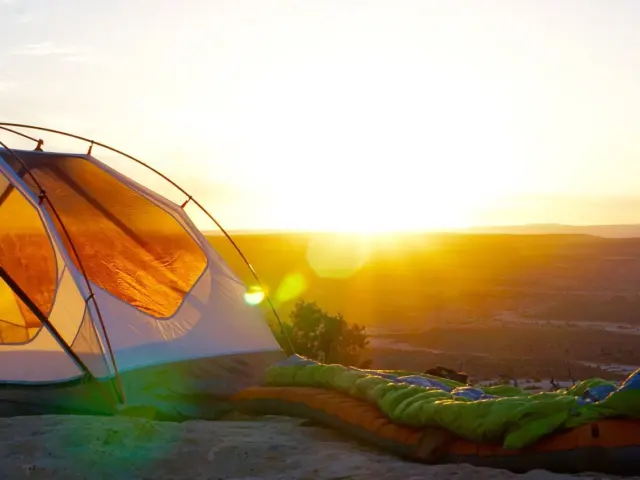

Lying awake cold in your tent is miserable, and it is fixable. The short answer on how to stay warm while camping: insulate the ground beneath you first, then match your bag, layers and habits to the night.
This page sits inside the camping guide, which covers the wider basics of planning a trip outdoors.
| Item | Value |
|---|---|
| Sleeping pad R-value for warm summer trips | 1 – 2 |
| Sleeping pad R-value for spring and fall | 3 – 4 |
| Sleeping pad R-value for near-freezing nights | 5+ |
| Warmth a weak pad can take from your bag | More than 20 degrees |
| Pad R-value at which a 16-degree test bag performed at its rating | Around 5 |
These figures come from Core Equipment’s R-value guide and Outdoor Life’s 2023 explainer. Ratings and recommendations can change, so check the source before you rely on them.
Why you get cold in a tent
Voyageur Tripper explains that there are four ways your body loses heat: evaporation, conduction, radiation and convection. Its summary is simple: you stay warm camping by keeping yourself dry, using insulation and minimizing contact with the ground.
The same source notes that you are most likely to feel the cold at night, because the temperature drops and you stop moving. Being cold can also become dangerous really quickly in some conditions, so treat a restless, shivering night as a signal to add insulation.
That gives you three jobs to work through:
- Keep sweat and damp away from your skin.
- Insulate both above and below you, since a winter sleep system is insulation above you and insulation below you.
- Cut contact with cold ground as much as you can.
Start with the pad under you
Many campers see a sleeping pad as a comfort item. Outdoor Life says its real job is to protect you from the cold of the ground, and that a pad that isn’t up to the task can compromise the warmth of your sleeping bag by more than 20 degrees, according to its 2023 article.
The number to look for is R-value. Core Equipment defines it as how well a sleeping pad resists heat loss, and it offers these general ranges:
- R-value 1 – 2: best for warm summer camping trips.
- R-value 3 – 4: a versatile range for spring and fall camping.
- R-value 5+: designed for cold weather camping and near-freezing temperatures.
Outdoor Life shared REI test results using a bag with an ISO limit rating of 16 degrees. Here is how the same bag behaved over different pads:
- Air-only inflatable pads: it acted like a 33-degree bag.
- A pad with an R value of 2, typical of closed-cell foam: it acted like a 28-degree bag.
- A standard insulated pad with an R value close to 4: it acted like a 19-degree bag.
- A pad with an R value around 5: it finally performed as a true 16-degree bag.
Do not judge a pad by its height. Outdoor Life points out that thickness when inflated is not a good indicator of warmth, because some pads hold only air while others contain insulating material.
If a cold snap catches you out, layering two pads is a cheap fix. Core Equipment suggests, for example, pairing a foam pad with an inflatable one for extra protection from the ground and better comfort.
Match your sleeping bag to the coldest night
Temperature ratings are a useful benchmark, not a promise. Trekitt notes that EN/ISO testing assumes a sleeping mat with an R-value of 5, so a pad with a lower R-value can significantly reduce how warm a bag feels in real conditions.
Voyageur Tripper adds that temperature ratings assume you are using an appropriate sleeping pad and are wearing base layers. In other words, the bag, the pad and your clothing are rated as one system.
For cold use, Trekitt’s rule of thumb is to pick a comfort rating lower than the coldest temperature you expect. That buffer helps on long nights, in bad weather and when you are tired.
Fill type matters too. Down excels in cold, dry conditions, while synthetic bags are bulkier but retain insulation better when damp, according to the same Trekitt guide.
Dress for bed and add a liner
What you wear inside the bag counts. Voyageur Tripper’s quick tips for sleeping warm include:
- Wear wool socks and a wool hat when sleeping.
- Wear merino wool base layers as pyjamas, and avoid cotton.
- Dress in layers during the day and avoid overheating, so you are not sweating into your clothes before bed.
A sleeping bag liner is a low-cost upgrade if you are only a little cold. Voyageur Tripper says a liner can add 5 to 15 °F of warmth to your bag, and recommends synthetic material such as polyester or fleece, or silk, rather than cotton.
Habits that help you stay warm until morning
Try a hot water bottle. Fill a stainless steel bottle or Nalgene with boiled water before bed and put it in your sleeping bag while you change and brush your teeth. Voyageur Tripper suggests keeping it between your thighs rather than at your toes.
Your body also needs fuel and fluid. The same guide advises you to consume lots of calories and stay hydrated, and our list of easy camping meals is a good place to find simple dinners that take little effort after a cold day.
Keep snacks out of your sleeping area. Read how to store food while camping bears so a late bite does not leave food in your tent.
Frequently asked questions
What R-value do I need for cold weather camping?
Show answer
Core Equipment’s general guide puts R-value 5+ as the range designed for cold weather camping and near-freezing temperatures. Your own destination, weather and comfort preferences should shape the final choice.
Can a sleeping bag liner replace a warmer bag?
Show answer
It can help if you are only slightly cold. Voyageur Tripper says a liner can add 5 to 15 °F, which is a modest gain, so a much colder forecast still calls for a warmer bag or pad.
Is a thicker sleeping pad always warmer?
Show answer
No. Outdoor Life says inflated thickness is not a good indicator of warmth, so check the listed R-value instead.
Should I choose a down or synthetic sleeping bag?
Show answer
Trekitt says down excels in cold, dry conditions, while synthetic bags are bulkier but keep their insulation better in damp conditions.